The Salesforce Tasks alternative built for salespeople
Senaro AI is the task manager built for salespeople, with account tiles, sales-native tags, and invisible AI on day one. Salesforce Tasks is a great crm-native task tracker, just not built for sales work.
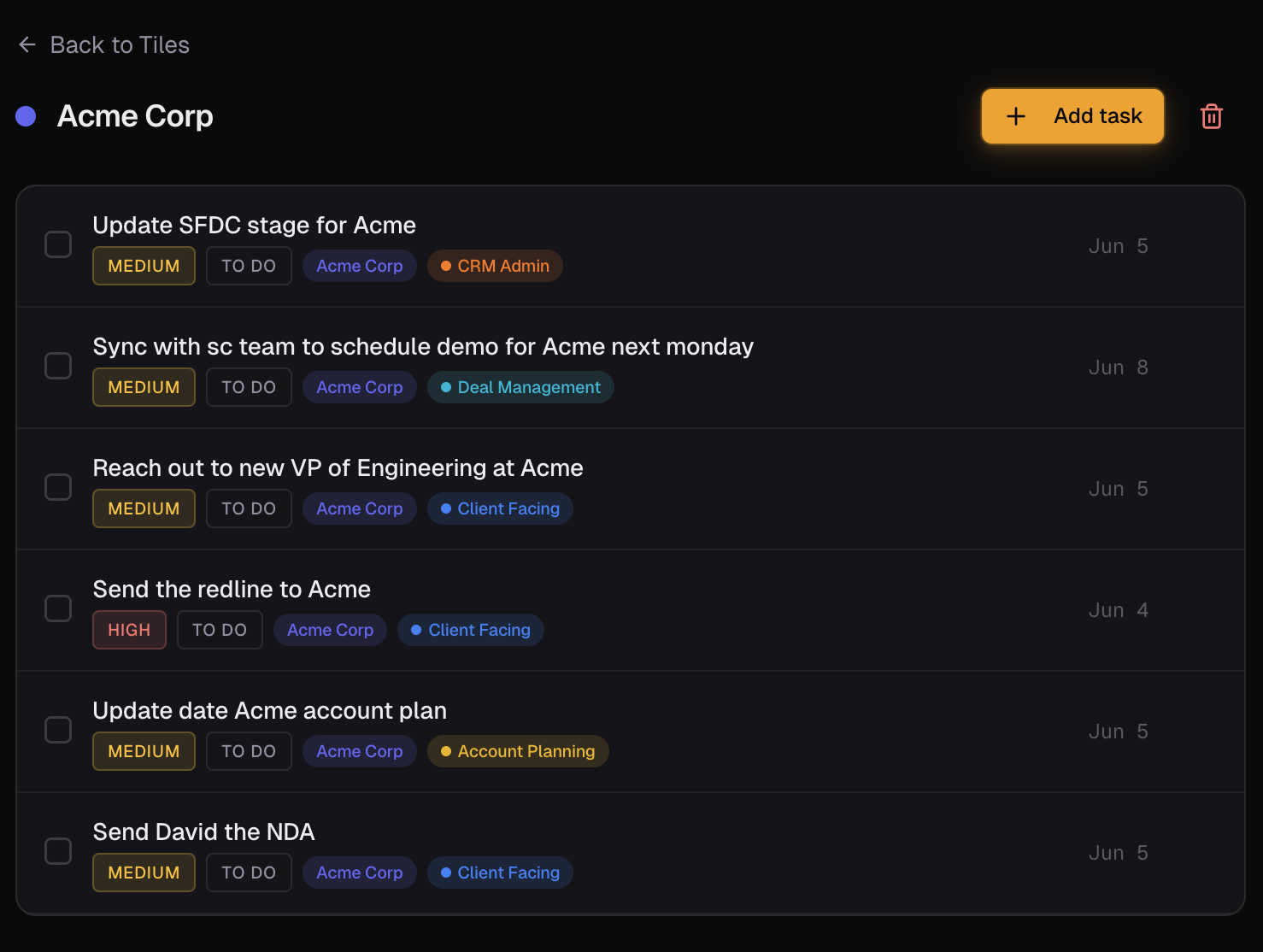
Salesforce Tasks is for your manager. Senaro AI is for you. Use Senaro as your personal task layer alongside Salesforce, type follow-ups the way you would say them out loud, and stop running your real day from Notes.
Why salespeople look for Salesforce Tasks alternatives
- The task UX is famously slow. Multiple clicks to log a single follow-up, plus required fields, plus the page reload. Reps simply do not use it for anything except what the manager requires.
- It is built for reporting first and for the rep last. Tasks are a data point for the activity dashboard, not a planning tool.
- There is no AI that reads what you actually typed. Einstein activity capture is automation around emails and meetings, not freeform task parsing.
- Capturing the long tail of follow-ups (the side-tasks from calls, the personal reminders, the 'check on this account next week') does not fit the data model, so it lives outside Salesforce entirely.
- Every rep has the same workaround: Notes, sticky notes, a private spreadsheet, or 'I'll remember it'. None of those scale, and renewals slip through the gap.
Senaro AI vs Salesforce Tasks at a glance
| Dimension | Salesforce Tasks | Senaro AI |
|---|---|---|
| Built for | Sales managers, RevOps, activity reporting | Salespeople (AEs, SDRs, CSMs, sales managers as ICs) |
| Speed of entry | Multi-click form tied to record creation | Single input. Type a sentence, hit Enter, AI fills the rest |
| AI parsing | None on the task. Einstein captures emails and meetings, not freeform tasks | Invisible AI. Reads your sentence and files to the right account, due date, and tag |
| Accounts and deals | Tied to Account, Opportunity, Lead records | Account tiles built in. No Salesforce dependency |
| Tagging system | Custom task types and picklists configured by admin | Sales-native tags out of the box (Client Facing, CRM Admin, Deal Mgmt, Prospecting, etc.), plus unlimited custom tags on Pro |
| Bulk capture from meeting notes | Not supported in core Tasks | AI Import: paste a meeting note, get a structured task list back filed to accounts |
| Follow-up suggestions | None on the task itself | Complete a client-facing task, get an AI-suggested next step in one click |
| Manager visibility | Full visibility via activity reports | Personal account. Manager cannot see your private task list |
| Pricing | Bundled with Sales Cloud. Starter $25+/user/month, Enterprise $165+/user/month | $11/month or $99/year. 14-day Pro trial automatic, no card |
How they actually differ
Senaro sits next to Salesforce, it does not replace it
Salesforce is the system of record. Your forecast lives there, your manager looks at it every Monday, and most internal process touches it somewhere. None of that goes away.
Senaro is the personal task layer the rep runs their day from. The 50 small follow-ups, redlines, recaps, and next-step reminders that today live in Apple Notes or a sticky note. When something needs to make it back into Salesforce as an Activity, it does. The point is to stop dropping the long tail in the gap between the call and the CRM update.
Why the Salesforce task UX never fit
Logging a single task in Salesforce takes more clicks than most reps will tolerate in the middle of a busy day. The fields exist because reporting needs them. The rep pays the cost.
Senaro inverts that. You type one sentence. The AI fills in the account, the due date, the tag, and the urgency. The whole interaction is sub-second. The same task that would take 30 seconds and three page loads in Salesforce takes one keystroke and Enter in Senaro.
The privacy of a personal task list
Salesforce Activities are visible to your manager and your manager's manager. That is the design. For real customer-facing work, fair enough. For your personal triage list ('check on the Initech redline, ping legal about the Acme MSA, follow up with the prospect who ghosted'), not really.
Senaro is a single-user account that you pay for on a personal card. There are no team workspaces, no admin console, no manager view of rep activity. The list is yours. You decide what gets pushed back into Salesforce.
Pricing in context
Salesforce is paid by the company. Most reps never see the line item. That does not mean Salesforce Tasks fits the rep's workflow, just that the cost is hidden inside a larger contract.
Senaro at $11/month is paid by the rep on a personal card. It sits below any procurement threshold, the trial requires no card, and the value shows up on the first Monday morning when the day is already sorted.
Who should switch (and who should stay)
Switch to Senaro AI if
- AEs on Salesforce who actually run their day from Notes because the Salesforce task UX is too slow to use in real time
- SDRs whose research and side-tasks never make it into Salesforce because the friction is too high
- CSMs juggling renewals, expansion, and health work across 30 to 80 accounts where Salesforce Tasks decay quickly
- Reps who want a private layer their manager does not see by default
Stay with Salesforce Tasks if
- Reps whose internal process strictly requires every task to live as a Salesforce Activity from the moment of creation
- Anyone whose company prohibits non-approved SaaS for sales activity
- Sales orgs where the manager dashboard is the only legitimate place a task can live
How to move from Salesforce Tasks
Most reps run Senaro and Salesforce side by side. Salesforce stays the system of record. Senaro becomes the place you actually plan from. Set up account tiles in five minutes using the AE / SDR / CSM starter template, then capture every new follow-up in plain English via quick-add or AI Import. Push the items that belong in Salesforce back as Activities on your own cadence (most reps do this once a day, not once a task).
Frequently asked questions
Does anyone actually use Salesforce Tasks to manage their day?
Plenty of reps log activity in Salesforce Tasks because the report needs it, but few plan their actual day from it. The capture flow is too slow for the long tail of follow-ups, so the real to-do list ends up in Notes, a notebook, or a spreadsheet. Senaro AI gives you a fast personal layer to plan from, alongside Salesforce, so follow-ups stop slipping in the gap.
How do I manage calls and tasks in Salesforce more efficiently?
The setup most reps land on is to keep Salesforce as the system of record and run a faster personal task layer beside it. Capture every follow-up in one line the moment it comes up, work from a single sorted daily plan, and push the activity that matters back into Salesforce once a day rather than logging each task through the panel mid-call.
Does Senaro AI replace Salesforce?
No. Salesforce is your CRM and your manager's reporting platform. Senaro is your personal task layer. They sit side by side and do different jobs.
Does Senaro AI integrate with Salesforce?
Not today. Senaro is standalone by design, so you can start using it in minutes without an IT conversation or admin involvement. Salesforce integration is on the roadmap. In the meantime most reps use both tools in parallel.
Can my manager see my Senaro tasks?
No. Senaro is a single-user account that you pay for on your personal card. There are no team workspaces, no manager dashboards, and no admin console in the current product. Your task list is yours.
Is the price worth it if Salesforce Tasks is included in our contract?
Different products doing different jobs. Salesforce Tasks is built for activity reporting. Senaro is built for the rep's day to start sorted instead of triaged. Most reps make the call in the first half hour of a Monday morning.
Does Senaro AI work on mobile?
Yes. Senaro AI is fully optimised for iPhone Safari with a bottom tab bar and mobile-safe dialogs. Capture a follow-up on the way out of a meeting, review your sorted plan, and check your account tiles from the phone.
Is my data safe?
Yes. Encrypted in transit and at rest. Customer data is never used to train AI models. Only task text is sent to our AI provider for parsing, never your account data, and you can pause AI processing at any time in Settings.
Keep comparing
Weighing up more than one tool? Read our ranked guides to the best sales task managers and the best free task managers.
Or see how Senaro AI compares to Todoist, HubSpot Tasks, Notion, Motion and TickTick.
Still keeping follow-ups in a notes app? Read track sales follow-ups, track next steps without salesforce, stay organized as a sales rep and salesforce tasks vs hubspot tasks.
Ready to stop dropping follow-ups?
14 days of Pro, no card. Drops to Free after if you do nothing.

Built by Arjun Sinha. 13+ years on the sales front line before founding Senaro AI, including AE, Sales Leadership, and GTM Consulting at Series A+ SaaS companies. Senaro AI is built around how a sales day actually flows, not how a product manager imagines one does.